

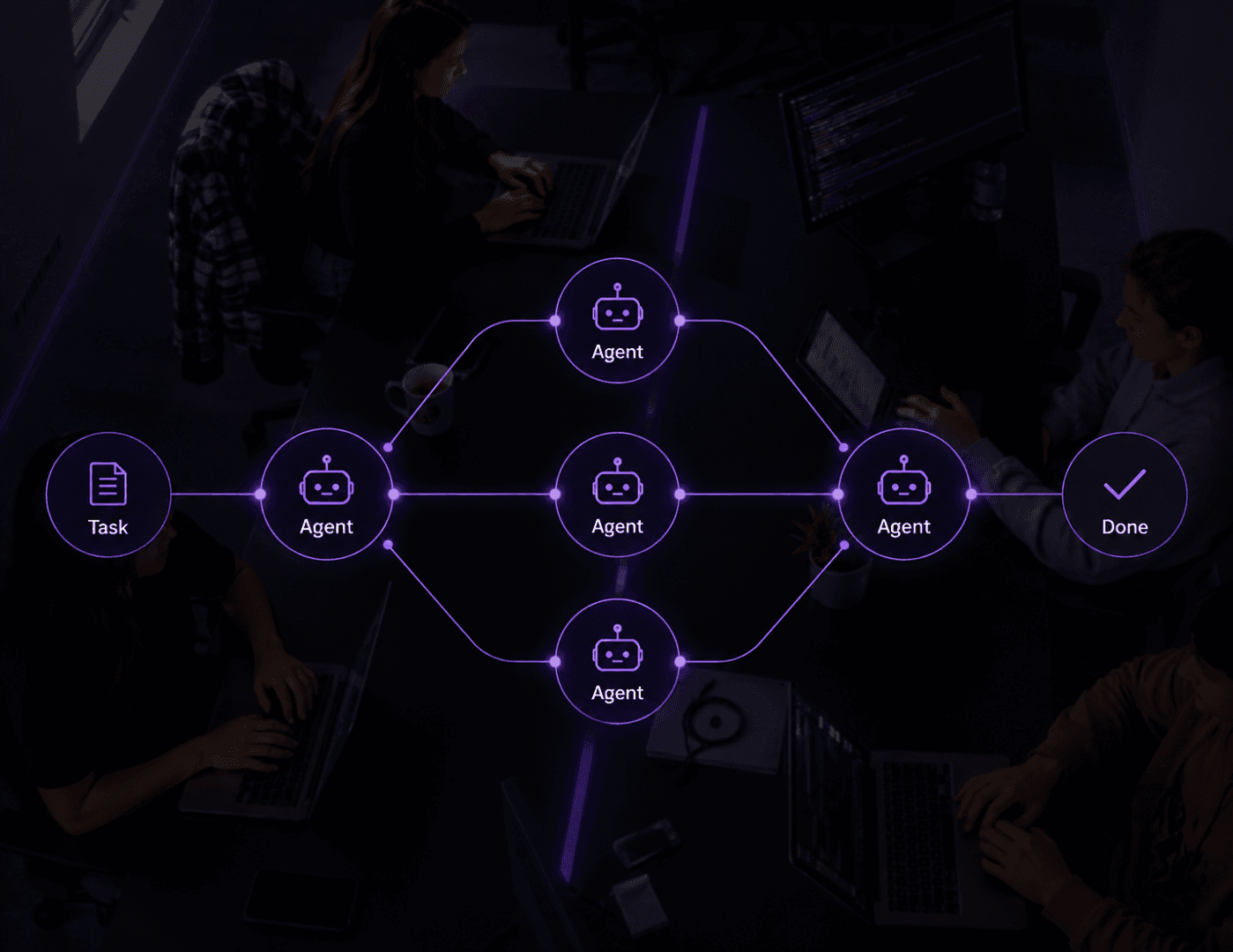
Agentic Pipeline
One AI agent gets access to the repository, terminal, database, and a dozen APIs. It must understand the task, find context, write code, test it, and review itself. That's convenient for a demo. In production, this "universal agent" quickly becomes hard to control.
Why one large agent does not scale well
The more roles an agent performs, the larger its prompt, toolset, and context become. Selecting the right tool, preserving the requirement, and noticing mistakes all get harder.There's also a conflict of roles. Asking the agent that just built a solution to review it independently is like asking a pull request author to approve their own code.An agentic pipeline separates the process into narrow responsibilities.
What this looks like in practice
Imagine a task to add rate limiting to an API.A coordinator converts the request into acceptance criteria. A read-only research agent finds the existing middleware, state-storage pattern, logging rules, and tests, then returns a structured report with file references.An implementation agent receives that report, with write access limited to the relevant files. A test agent runs verification. Finally, a reviewer receives the specification, diff, and results. It can't edit the code — only accept it or send back specific findings.The stages exchange plan.md, a patch, a test report, and a review verdict. That's more reliable than hoping all the context survives in one endless conversation.
What specialization gives you
Each agent can have its own prompt, model, tools, permissions, and evaluation criteria. The researcher needs no write access. The reviewer needs only the requirements and diff. Formatting should still go to a linter, not an LLM.In Anthropic's research system, a multi-agent setup outperformed one agent by 90.2% on an internal evaluation. Parallel subagents and tool calls reduced complex research time by up to 90%.But those numbers shouldn't be applied blindly to every engineering task.
Multiple agents are not a free upgrade
The same system used roughly 15 times more tokens than a normal chat. Multiple agents also add latency, harder debugging, and lossy handoffs.They work best when work divides cleanly and every stage has a verifiable output. For a small CRUD change, five agents may cost more than the task itself.So don't start by assembling an "AI team." Find the stage where your general-purpose agent fails most often, split that responsibility out, and give it a measurable quality gate.An agentic pipeline isn't really about the number of bots. It's about clear boundaries of responsibility.