

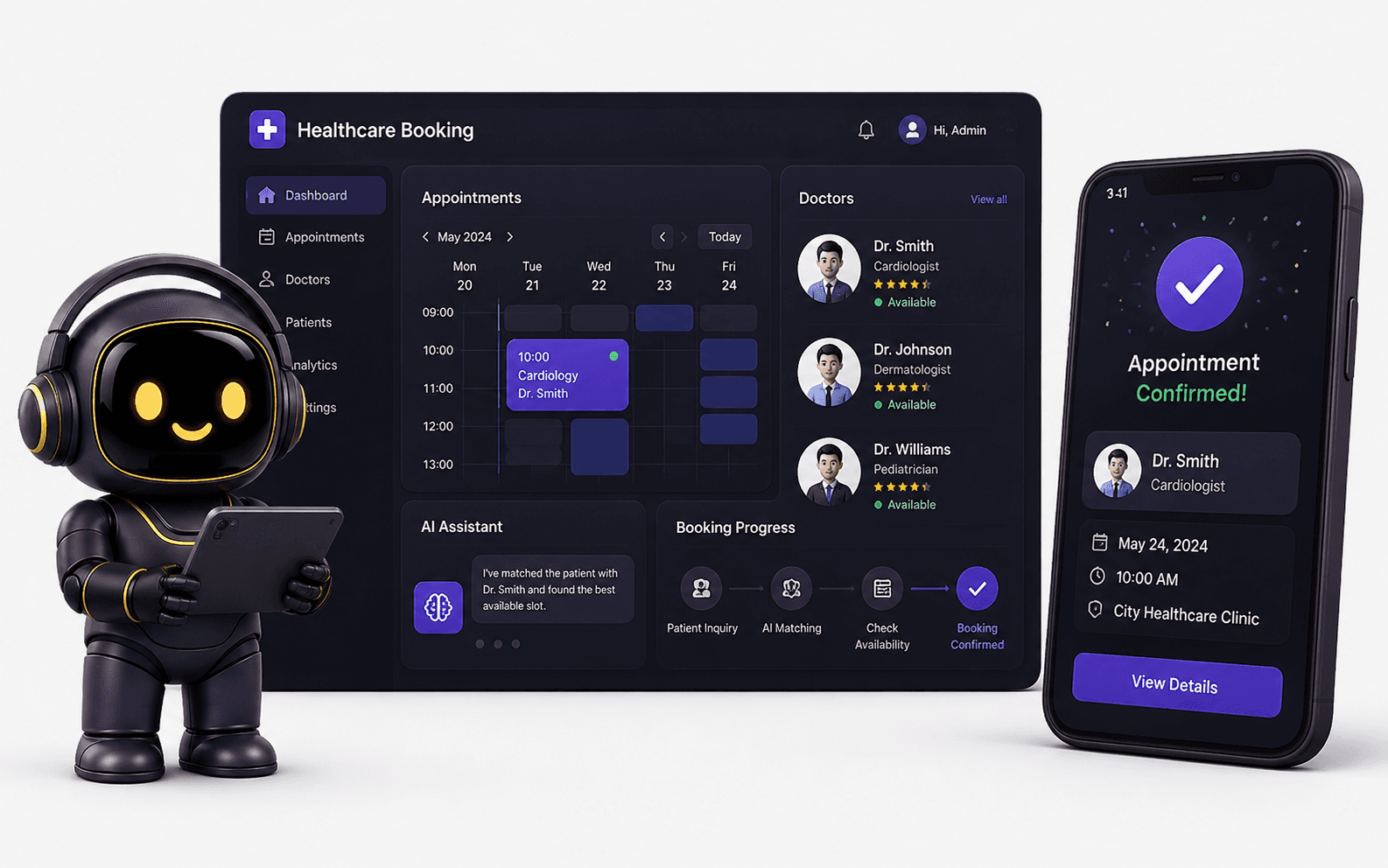
AI-Powered Healthcare Booking Platform
A growing digital health startup came to us with a booking process stitched together from spreadsheets, a third-party scheduling plugin, and a lot of manual follow-up calls. It worked, in the sense that appointments eventually got made. But the seams were showing everywhere: patients dropped off mid-booking because the flow asked too many questions before showing a single available slot, front-desk staff spent hours a day confirming appointments by phone, and doctors' calendars filled up unevenly because there was no real logic matching a patient to the right specialist — just a static list sorted alphabetically.The founders weren't looking for a prettier calendar widget. They needed the booking system to stop being the bottleneck between a patient wanting care and a doctor being available to give it.
Where the time was actually going
Before writing a line of code, we mapped where staff hours disappeared. The answer wasn't glamorous: most of it went into work that didn't need a human judgment call at all — confirming a slot is still open, reminding a patient twice before a visit, re-routing a booking when the first-choice doctor was full. None of that required a person. It required a system that could see availability and patient context at the same time and act on it immediately.
What we built
We designed and built a platform where AI handles the matching and scheduling work that used to sit on someone's desk.AI-assisted doctor matching routes a patient to the right specialist based on symptoms, availability, and history, instead of a dropdown list a patient has to guess their way through. Instant appointment scheduling shows real, live slots the moment a patient opens the booking flow — no back-and-forth calls to confirm what's actually open. Secure video consultations are built directly into the booking flow itself, so patients never have to juggle a separate app or a link buried in an email. Automated reminders go out on a schedule tuned to reduce no-shows, without anyone on staff writing or sending a single message.None of these pieces work in isolation — the value is in how tightly they're wired together. A booking made at 11 p.m. on a Sunday triggers the same matching logic, the same confirmation, and the same reminder sequence as one made by a receptionist at 9 a.m. on a Tuesday. The system doesn't sleep, and it doesn't need someone watching it to keep functioning correctly.
The engineering challenge that mattered most
The hard part wasn't generating a match or sending a reminder — those are solved problems. The hard part was making sure the AI matching logic never quietly made a decision a doctor would disagree with. We built the matching layer to work within clinical guardrails set by the clinic itself: which conditions route to which specialties, which cases always get flagged for human review instead of auto-booking, and how availability data stays accurate in real time even when a doctor's calendar changes minutes before a patient tries to book. Getting that boundary right — automate the routine, escalate the exception — was most of the actual engineering work.
The result
Patients now book the right healthcare professional in under two minutes, down from a process that used to require a phone call and a wait for a callback. Clinics using the platform handle 45% more appointments with significantly less administrative work, because the system handles matching, confirming, and reminding on its own instead of routing every step through a person.The time that used to go into re-typing appointments into a second system and chasing no-shows by phone now goes into the part of the job that actually needed a human: patient care, not calendar admin. The platform didn't replace the front desk. It removed the parts of the job that never needed a human in the first place — and left the staff free to handle the parts that do.