

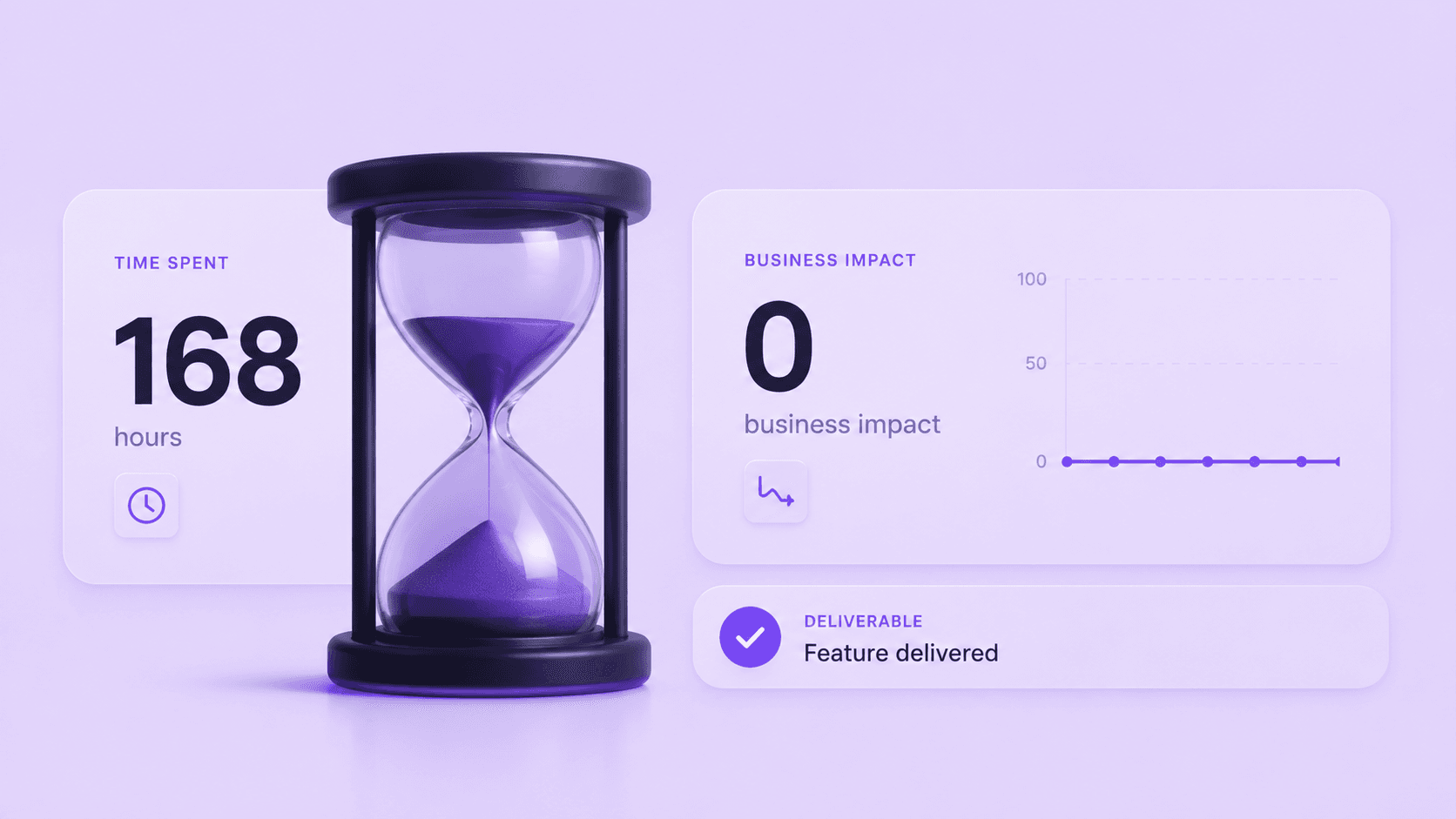
Every development contract promises the same thing on paper: we'll build the product, on time, on budget. No contract is ever written as: "we bill for effort, not outcome." But some teams operate exactly on that principle — nobody just says it out loud. And a founder usually doesn't notice until about a year into "progress" that never turned into a product.This isn't about fraud. It's about where a team's incentives point. If a vendor is paid by the hour, it's logical that they'll optimize the process around hours. Below are concrete signals you can catch before you've burned through budget and time.
The invoice looks perfect. The product doesn't
This is the first and most visible signal. Hours are logged, sprints close on time, reports are clean — and the thing you actually want to ship is still six weeks away, same as it was six weeks ago. Activity and progress are not the same thing. A team billing by the hour has no structural reason to tell these two apart for you — if anything, the longer the difference stays invisible, the longer the contract runs.
Every conversation turns into scope, not the problem
Ask a results-oriented team: "should we build this feature" — and you'll get a question back about what user problem it solves. Ask the same thing to an hours-oriented team, and they'll ask whether it's in scope. Neither answer is dishonest — it's just where the incentives point. A team paid for time treats scope as something that protects their hours. A team accountable for outcomes treats scope as something that protects your product.
Estimates only move in one direction
Every project has surprises — that's normal, and a vendor who never revises an estimate is probably not being honest with you either. The question isn't whether the estimate changes, it's the direction. If timelines and budget only ever grow, and grow roughly in proportion to how much runway you have left, that's not bad luck. That's a team that's learned your ceiling and is building the project around it.
You're never told "no"
This is a counterintuitive signal because at first glance it looks like great service. A vendor who agrees to everything, implements every request, and never pushes back isn't necessarily on your side. Often, they're just avoiding a conversation that would cost them a sprint. A team truly accountable for outcomes will tell you when a request will hurt the product, even if that request is your own. That friction isn't a service failure — it's a sign that someone is actually thinking about the product, not just the ticket.
No one can explain the architecture without opening the code
Ask a senior on the team to explain, without Google and without an open editor, how the system is built and why. A team accountable for outcomes can do this in five minutes — because they think about the system between tickets, not only while working on them. A team selling hours against a backlog often can't — because there's no one whose job is to hold the whole picture in their head, rather than just the task in front of them.
What to ask before signing anything long-term
You don't need to understand the code to catch this early. A few concrete questions are enough:What happens if a sprint reveals the original plan was wrong — does the team flag it, or quietly close it out with extra hours?Who on the team is accountable for whether the product succeeds, not just whether tickets are closed?How did the team behave when they made a mistake with a past client — not in theory, but with a specific example?The answers to these three questions will tell you more about a vendor than any portfolio or Clutch review.An honest development partner will, at some point, cost you the feature you wanted, an estimate you don't like, or an uncomfortable conversation you'd rather avoid. That's not a red flag. The red flag is when none of that ever happens.