

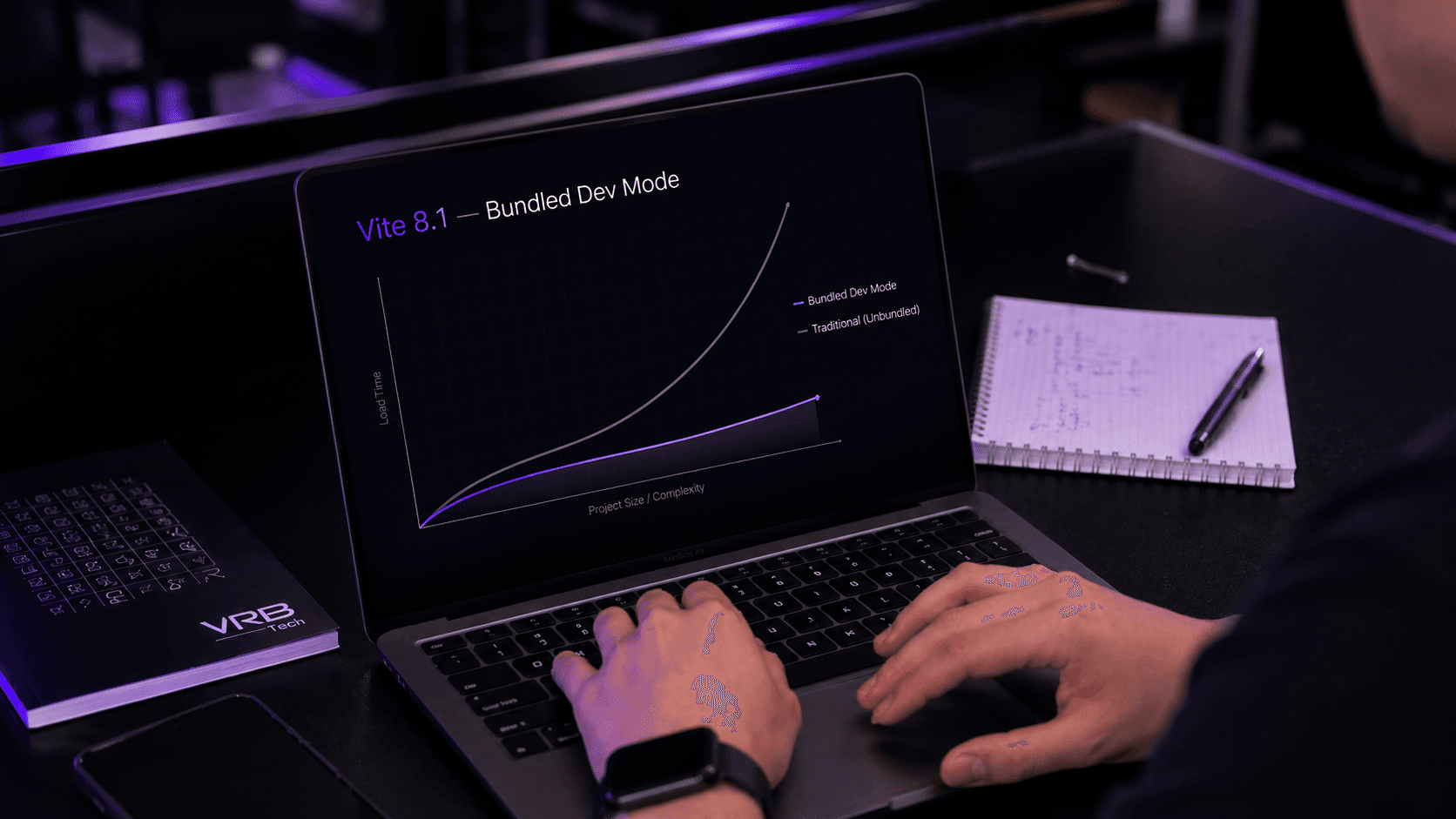
Vite 8.1 — Bundled Dev Mode
Vite changed frontend development with a simple idea: don't bundle the entire application before starting the dev server.The browser requests modules individually, Vite transforms them on demand, and the project becomes available almost immediately. This helped make Vite the default for many frontend projects.Now Vite 8.1 introduces an experimental Bundled Dev Mode. Bundling is coming back to development.
When an advantage becomes a bottleneck
The unbundled approach works extremely well until an application becomes very large.If a page depends on thousands of modules, the browser must request, parse, and execute each one. Add a network proxy or remote environment, and fast startup turns into hundreds or thousands of requests.At that point, the bottleneck is no longer how quickly Vite transforms one file. It's the overhead of coordinating a huge number of small operations.
What Vite 8.1 changes
Bundled Dev Mode groups modules in advance and sends fewer, larger files to the browser while preserving instant Hot Module Replacement.In the Vite team's test with an application containing 10,000 React components, bundled mode delivered roughly 15x faster startup and 10x faster full-page reloads. HMR remained fast regardless of application size.Linear also reported up to 3x faster cold-start rendering, 40% faster full reloads, and 10x fewer network requests.That cuts the waiting developers feel every time they start a project or do a full refresh.
Why this is possible now
Vite 8 replaced its old combination of esbuild in development and Rollup in production with Rolldown, a single Rust-based bundler.Vite can now use one pipeline across both environments instead of aligning two transformation systems. Bundling in development isn't a return to the slow tooling of the past. It's a different trade-off, built on a faster foundation.
Should every project enable it?
Probably not. Small and medium projects may see little benefit because the standard unbundled server is already fast. Bundled Dev Mode is also experimental in Vite 8.1, so teams should validate plugin compatibility, source maps, and HMR behavior on their own codebase before adopting it.For a large frontend monolith, however — especially one running through a proxy or remote environment — it is an experiment with clear metrics: startup time, reload time, and request count.The broader lesson goes beyond Vite. A good architectural idea doesn't suddenly become bad. At a different scale, its trade-offs simply change places.